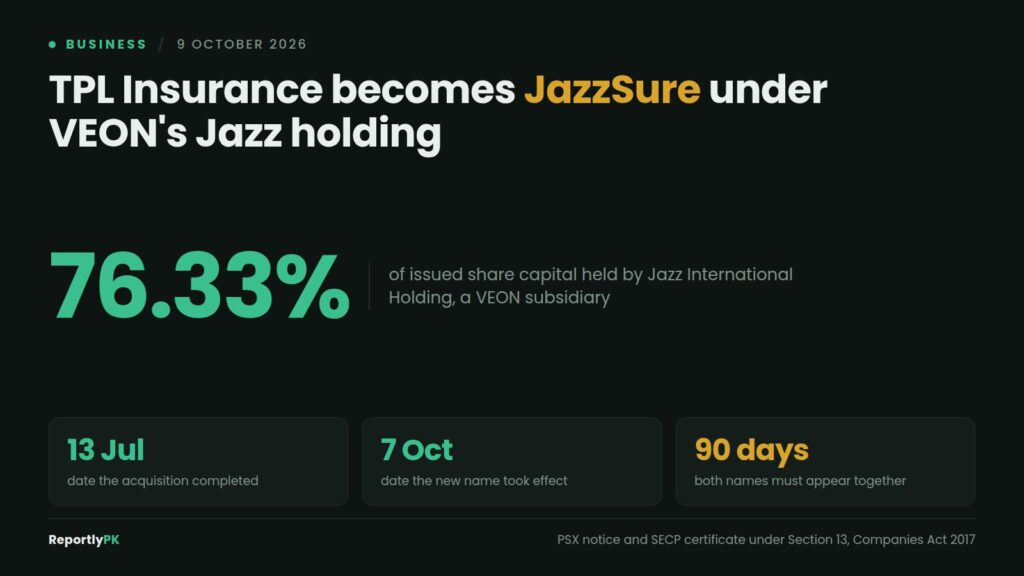
A listed Pakistani insurer now carries a telecom brand. The TPL Insurance JazzSure rebrand took effect on 7 October, completing the transfer of identity that followed Jazz International Holding Limited’s acquisition of a controlling stake earlier this year.
Jazz International Holding, a subsidiary of VEON, holds 76.33 percent of the company’s issued share capital. The acquisition completed on 13 July; shareholders approved the renaming at an extraordinary general meeting on 2 October; and the notice of the change was filed with the Pakistan Stock Exchange with effect from 7 October.
The paperwork, and the 90-day rule
- Stake held by Jazz International Holding: 76.33 percent
- Acquisition completed: 13 July 2026
- EGM approving the name: 2 October 2026
- Name effective: 7 October 2026
- Certificate issued by SECP under Section 13 of the Companies Act, 2017
- Former name must appear alongside the new one for 90 days
The 90-day dual-name requirement is a standard protection, not a formality. Policyholders hold documents issued by TPL Insurance, and claims, renewals and correspondence will carry both names through early January so that cover is not disputed on the basis of a changed letterhead. The deal value has not been disclosed.
What VEON is assembling
Taken on its own, a telecom group buying an insurer is a diversification. Taken alongside what VEON already runs in Pakistan, it looks more deliberate: Jazz is the largest mobile operator by subscribers, JazzCash is one of the largest mobile wallets, and JazzSure now adds an underwriting licence to a distribution network that already reaches tens of millions of handsets.
The strategic logic is distribution. Insurance penetration in Pakistan is low by regional standards, and the conventional explanation is a shortage of agents, branches and payment mechanisms rather than a shortage of demand. A mobile operator with a wallet attached solves all three at once — identification through the SIM, collection through the wallet, and distribution through the app.
This also sits directly alongside the group’s raised capital commitment. VEON lifted its three-year Pakistan investment plan to $1.5 billion from $1 billion this week, and a licensed insurer is the kind of asset that a plan of that size would be expected to accommodate.
Related: VEON lifts its Pakistan investment plan to $1.5bn
Two regulators, one group
The arrangement puts a single corporate group under two supervisors with different mandates. Jazz’s telecom licence sits with the Pakistan Telecommunication Authority; the insurance business is supervised by the Securities and Exchange Commission of Pakistan, which issued the renaming certificate.
Neither regulator’s framework was written with the other’s sector in mind. The questions that follow are practical ones: whether subscriber data held under a telecom licence can be used to price or target insurance products, how a bundled offer is disclosed to a customer who thinks they are buying airtime, and which authority adjudicates a complaint that spans both.
No coordination mechanism between PTA and SECP has been announced for this group. The absence is not an allegation of anything — it is simply a gap that will need filling as the model develops, and one that other markets have had to address after the fact rather than before.
What the name change does not tell us
The renaming is a branding event. It says nothing about the insurer’s underwriting book, its solvency position, its claims ratio or what products it intends to sell under the new name, and none of those have been published alongside the announcement.
For the remaining 23.67 percent of shareholders, the relevant questions are about minority treatment and free float rather than the brand. A 76.33 percent holding gives the parent control of ordinary resolutions comfortably, and the company remains listed, so the terms on which minorities are treated become a live issue rather than an abstract one.
Why the licence was bought rather than built
VEON could in principle have applied for a new insurance licence rather than acquiring a listed insurer. Buying was the faster route, and the reasons are instructive about how these markets work.
A new licence requires building an actuarial function, a claims operation, a reinsurance panel and a regulatory track record from nothing, and the approval itself takes time that a three-year investment plan cannot absorb. An existing insurer arrives with all of it attached, along with the historical data needed to price risk — which a telecom group, however many subscribers it has, does not possess.
The trade-off is that the buyer also inherits the book as written, including whatever is in the reserves. Nothing has been disclosed about the quality of that book, and in insurance acquisitions that is usually where the surprises sit.
The test is whether penetration moves
Telecom-owned insurance has been tried in several emerging markets with mixed results. Where it has worked, the winning products have been simple, low-premium and bundled — device protection, basic life cover, hospital cash — rather than the motor and property lines that conventional insurers compete on.
Where it has disappointed, the cause has usually been that a mobile customer base converts into policy sales far more slowly than the subscriber numbers suggest. Having 70 million users is not the same as having 70 million prospects, and the gap between those two figures is where most of these ventures have found their limits.
The measure that will settle it is industry penetration data over the next two or three years, not the rebrand. If JazzSure’s arrival coincides with insurance reaching people who previously had none, the model will have worked. If it mostly redistributes existing policyholders between insurers, it will have been a change of signage.