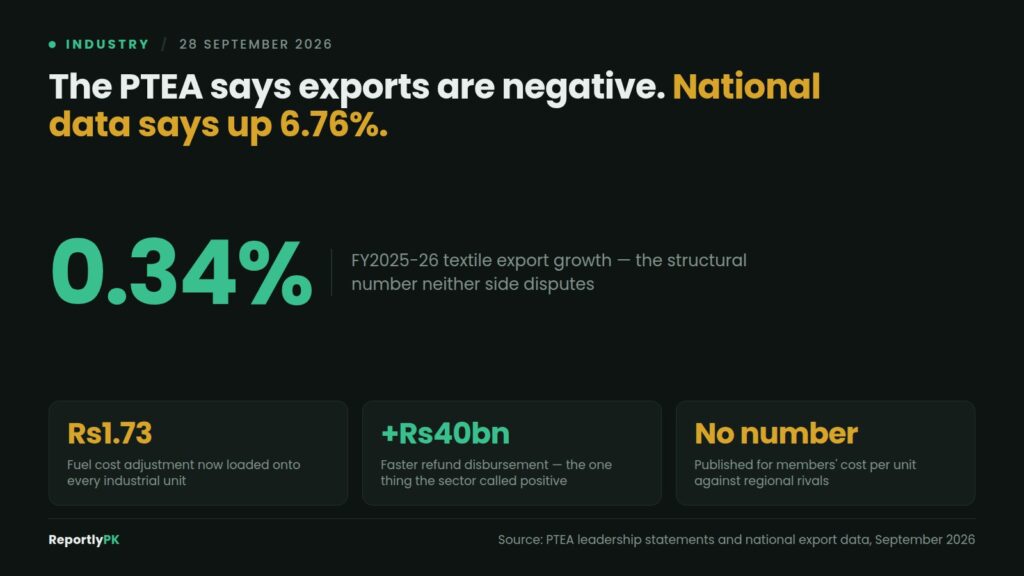
The rising textile cost of production is the foremost challenge facing exporters, according to Rehan Naseem Bharara, newly elected chairman of the Pakistan Textile Exporters Association. He also described export growth as negative since the start of the fiscal year.
National data says textile exports in July and August totalled $3.41 billion, up 6.76 percent on the same two months a year earlier. Both statements can be true, and working out how is more useful than deciding which one to believe.
Four ways the numbers reconcile
- Membership is a subset. An association reports what its members see. A group concentrated in value-added categories can be shrinking while the national aggregate, which includes cotton yarn and basic cloth, grows.
- Value is not volume. If unit prices rose, export value can climb while the number of containers leaving falls. Mills experience volume.
- The period may differ. September data is not yet public. An exporter describing the fiscal year to date may be counting a month nobody else can see.
- Margin is not revenue. Rising input costs compress profitability even when turnover grows.
The fourth is almost certainly what is being described, and it is the more serious complaint. Bharara’s stated concern is that the cost of doing business has discouraged fresh investment. That is a statement about returns, not about order books, and a sector can grow its revenue into a declining return for several years before the consequence shows up as unreplaced machinery.
Two of the three constraints moved this month
This site argued three weeks ago that Pakistani textile competitiveness turns on three variables, none of them textile policy as such: energy cost per unit of output, working capital tied up in unpaid tax refunds, and cotton supply.
Two of them moved in September, in opposite directions.
Refunds improved. The FBR disbursed about Rs197 billion across July and August against Rs157 billion a year earlier, and the outgoing PTEA chairman specifically credited refund clearance as a positive. That is the one line in this statement where the sector says something got better.
Energy got worse. Only one of seven contracted LNG cargoes arrived in August. Furnace oil generation rose 49 percent in a month, the blended fuel cost reached Rs8.83 a unit against a Rs7.10 reference, and distribution companies are recovering the Rs1.73 difference from consumers as a fuel cost adjustment.
A mill that reconnected to the national grid on the strength of lower tariffs received that adjustment for a gas supply failure it had no part in. When the PTEA chairman lists rising energy costs first, this is what he is looking at.
The FY26 number remains the real one
Whatever the disagreement about the current quarter, the structural fact has not changed. Textile exports finished FY2025-26 at $17.97 billion against $17.91 billion the year before — growth of 0.34 percent, or about $60 million added on a base of nearly eighteen billion dollars.
Against input cost inflation over the same period that is a real-terms contraction, in a year that also produced a credit rating upgrade, a record Eurobond and a fiscal deficit at a two-decade low. The macro improved and the export line did not follow.
The July-August start to FY27 is genuinely better — a monthly pace of about $1.705 billion against an FY26 average of $1.498 billion, roughly 13.9 percent higher. An association describing that as negative growth is describing something other than the national aggregate, and it should say what.
The ask is too vague to act on
The association wants a comprehensive strategy to reduce production costs, restored competitiveness, accelerated economic activity, and export policies revisited and redesigned.
None of that can be costed, legislated or refused, because none of it names a number. Compare it with what could have been asked for: an industrial power tariff fixed for a stated period, the monthly refund stock published so the Rs390 billion cap agreed with the IMF can be seen being observed, automatic compensation once a verified refund passes a set number of days, and a cotton import regime that does not price lint off a currency the mill cannot hedge.
Those are demands a finance ministry can say yes or no to. A comprehensive strategy is a demand nobody has to answer.
Publish the cost per unit
The single most useful thing the PTEA could do costs it nothing and it has not done it. Publish members’ average energy cost per unit of output, and set it against Bangladesh, Vietnam and India.
If Pakistani mills are paying materially more per kilowatt-hour than the competitors taking their orders, that is a number that settles the argument in one line and makes the policy case unanswerable. If they are not, the diagnosis needs revisiting. Either way the sector knows the figure and has chosen to argue without it, which is why a cost-of-production complaint that has been made every year for a decade keeps producing strategies rather than tariffs.
Related: Textile Exports Fell 12.71% in August. The Number That Matters Is 0.34%.