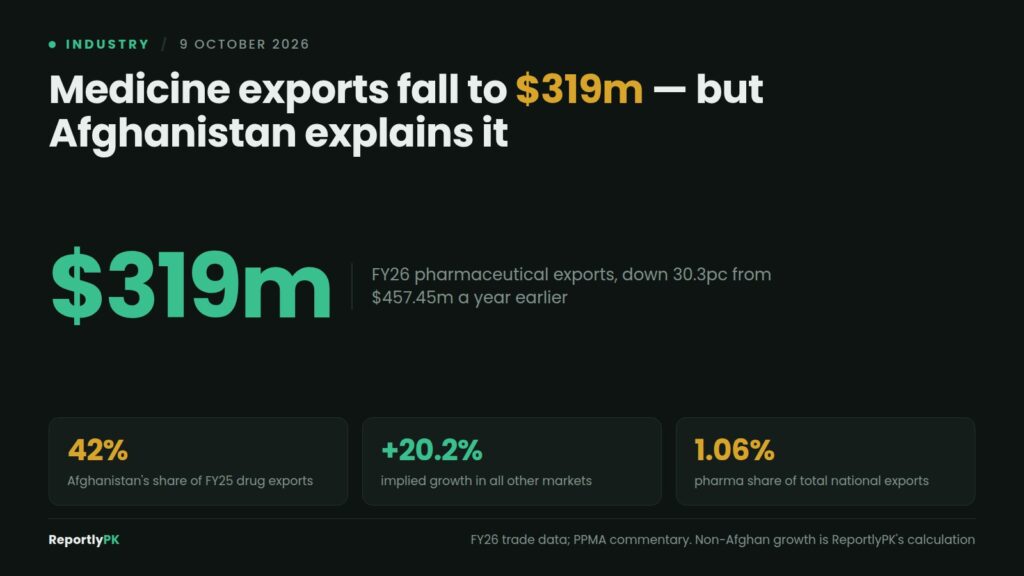
Pakistan’s pharmaceutical exports fell to $319.01 million in FY26, a three-year low and a drop of about 30 percent on the $457.45 million recorded in FY25. One market explains almost all of it.
Afghanistan accounted for 42 percent of Pakistan’s drug exports in FY25. The land border closed in October 2025, and sales of locally made medicines there stopped.
The figures
- FY26 medicine exports: $319.01 million, down 30.3 percent
- FY25 medicine exports: $457.45 million, up 34 percent that year
- Afghanistan’s share of drug exports in FY25: 42 percent
- Therapeutic goods overall: $771 million in FY26, from $990 million in FY25
- Total Pakistani exports: down 6 percent to $30.13 billion in FY26
Therapeutic goods — the wider basket that includes surgicals, food supplements, medical devices and nutraceuticals alongside medicines — fell 22.1 percent, a shallower decline than medicines alone. Pharmaceuticals shrank from 46.2 percent of that basket to 41.4 percent, so the contraction was concentrated in drugs rather than spread across the category.
The industry’s counterfactual holds up
Industry figures have said exports would have grown 20 to 25 percent in FY26 without the Afghanistan disruption. That kind of claim usually deserves scepticism. This one checks out.
If Afghanistan took 42 percent of FY25’s $457.45 million, that is about $192.1 million, leaving roughly $265.3 million sold elsewhere. FY26’s total of $319.01 million is $53.7 million above that non-Afghan base. Assuming Afghan sales went to zero, the rest of the book grew about 20.2 percent — the bottom of the claimed range, arrived at independently.
The assumption is the weak point: if any residual trade continued through third countries, the implied growth elsewhere is lower. But the order of magnitude is right, and it changes how the headline should be read. This was not a sector losing competitiveness across the board. It was a sector growing everywhere except in the one market that happened to be its largest.
The same arithmetic casts the FY25 comparison in a different light. That year’s 34 percent rise, reported as the best growth rate in two decades, rested on a market that was about to close. A base inflated by Afghan demand makes the FY26 fall look steeper than the underlying business warrants.
Related: Pakistan’s trade deficit widens 15pc to $10.79bn in Q1 FY27
The other two causes
Beyond the border closure, two pressures came from the same source. Higher oil prices following the US-Iran conflict raised transport costs, which bites hardest in low-margin markets where a few cents a unit decides whether a tender is won. Middle East tensions also delayed shipments moving by land and air to several otherwise viable destinations.
Neither is within the industry’s control, and both are the same forces that have shown up in the national trade figures and in this year’s fuel prices. The markets where Pakistani firms already have a presence — Sri Lanka, the CIS states, the Far East, Vietnam and Cambodia — are precisely the price-sensitive destinations where freight costs decide competitiveness.
Registration and inspection are the structural barrier
The slower-burning constraint has nothing to do with freight. Registering a new medicine in a foreign market takes a long time, and foreign regulators are often slow to travel to Pakistan to inspect manufacturing facilities before approving exports from them.
That second point is the binding one. A firm cannot sell into a regulated market until an inspector has walked its plant, and the scheduling of those visits sits with the importing country. It is a diplomatic problem as much as a commercial one, which is why the proposed remedy is government-to-government engagement rather than anything a company can do alone.
A rounding error in the national accounts
Some perspective on scale is needed before the policy asks are weighed. At $319.01 million, pharmaceuticals account for about 1.06 percent of Pakistan’s $30.13 billion in total exports. The entire $138.4 million decline is worth roughly 0.46 percent of the national export base.
That is not an argument for ignoring the sector. Pharmaceuticals are high-value, employ skilled labour and sell into markets where approval itself is a barrier to entry — all characteristics Pakistan’s export mix is short of. A dollar of medicine exports carries more development content than a dollar of raw cotton.
But it does set the terms for the foreign-exchange retention request. Raising the retained share from 15 to 35 percent of a $319 million book moves roughly $64 million a year of dollar inflows from the State Bank to exporters. That is small against reserves of $21.45 billion — and the precedent is the expensive part, because every other export association would have grounds to ask for the same treatment.
What the industry is asking for
Tauqeer Ul Haq, a former chairman of the Pakistan Pharmaceutical Manufacturers Association, is the figure quoted on the sector’s response. His association represents the manufacturers who would benefit from each measure proposed, which is worth stating plainly alongside the proposals themselves.
Three asks are procedural and cost little: engaging Afghan authorities to resume medicine flows despite the border closure, forming a committee with the Ministry of Commerce and TDAP to push on registrations and inspections, and formally notifying PharmaEx Pakistan as a trade body under TDAP — a proposal the Commerce Ministry reportedly approved in mid-2025 and has not implemented.
The fourth is different in kind. Exporters want the share of earnings they may retain in foreign currency raised from 15 percent to 35 percent, with the balance currently converted to rupees. That is a claim on the State Bank’s dollar inflows at a moment when reserves sit at $21.45 billion and the IMF is pressing on external buffers. It may still be the right call for an export sector that needs to pay for imported inputs, but it is a transfer rather than a procedural fix, and it should be argued on those terms.