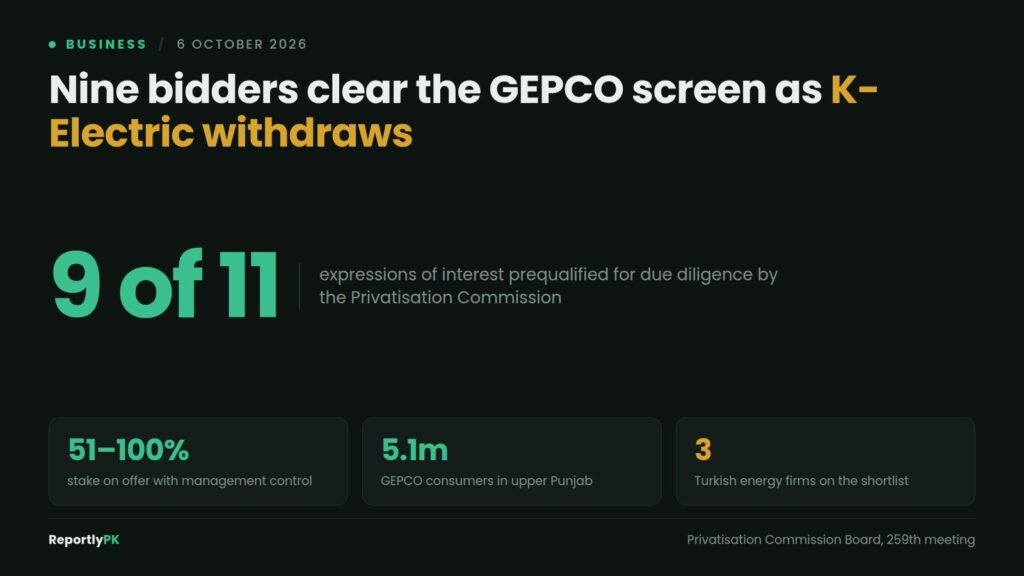
The GEPCO privatisation has cleared its screening stage. The Privatisation Commission Board, at its 259th meeting, prequalified nine of the eleven parties that submitted expressions of interest for a majority stake in Gujranwala Electric Power Company, opening the virtual data room to all nine for due diligence.
Two applicants did not make it through. K-Electric withdrew its expression of interest. Al Sharif Contracting & Commercial Development Co. Ltd. failed to submit the required documentation.
Who is through to due diligence
- Aktor Elektrik Enerji Yatirimlari San. Ve Tic. A.S. (Turkey)
- Genvera Enerji A.S. (Turkey)
- Cengiz Enerji Sanayii Ve Ticaret A.S. (Turkey)
- Engro Energy Limited
- Sapphire Fibers Limited
- Hub Power Holdings Consortium
- Shirazi Investments (Pvt.) Limited Consortium
- Artistic Milliners (Pvt.) Limited Consortium
- AKD Securities Consortium
The meeting was chaired by Muhammad Ali, the Prime Minister’s Adviser on Privatisation and Chairman of the Privatisation Commission. The stake on offer runs from 51 percent to 100 percent of shareholding, with management control attached.
Three Turkish firms and six Pakistani groups
The composition of the shortlist is the most informative part of it. Three of the nine are Turkish energy companies, which is the only meaningful foreign participation in the list. The remaining six are domestic, and four of those are consortiums rather than single entities.
Two of the Pakistani names come from textiles rather than power. Sapphire Fibers and Artistic Milliners are both large textile manufacturers, and both are among the industrial consumers whose electricity costs the privatisation is partly intended to address. Engro Energy and Hub Power Holdings are the two bidders with existing generation businesses; AKD Securities and Shirazi Investments are financial and diversified groups respectively.
K-Electric’s withdrawal removes the one bidder that already runs an integrated distribution utility in Pakistan, and with it the comparison that would have been most instructive for regulators: how a buyer with existing distribution experience prices a second licence area.
What GEPCO is
GEPCO distributes electricity across Gujranwala and the surrounding districts of upper Punjab, serving roughly 5.1 million consumers. That places it between its two sister companies in the current privatisation tranche: FESCO in central Punjab has about 5.7 million consumers, and IESCO in Islamabad, Rawalpindi and adjoining areas has about 4.1 million.
All three were put up for 51 to 100 percent stakes under a transaction structure approved by the Cabinet Committee on Privatisation, with staggered expression-of-interest deadlines through 2026. A $5,000 processing fee applied per company, and only prequalified investors gain access to detailed financial records and the right to bid.
Related: Ten investors file expressions of interest for IESCO privatisation
The reform case, and its limits
Officials have presented DISCO privatisation as a central pillar of Pakistan’s energy sector reforms, with private participation expected to improve governance, reduce transmission and distribution losses and lift service delivery.
The case rests on a specific mechanism: a private owner has a direct financial interest in cutting theft and improving recovery, where a state-owned distributor’s losses are absorbed by the circular debt. Whether that mechanism works in Gujranwala depends on enforcement powers the buyer may not control and on a tariff set by NEPRA rather than by the owner.
The Privatisation Commission has not published GEPCO’s loss percentage, recovery rate or current financial position alongside the prequalification announcement. Those are the figures that determine what the company is worth, and they sit inside the data room the nine bidders have just been given.
Why textile groups are bidding for a power utility
The presence of Sapphire Fibers and Artistic Milliners on the shortlist is worth explaining rather than skipping past. Neither is a power company. Both are export-oriented textile manufacturers for whom electricity is among the largest controllable input costs, and both operate in or near the Punjab belt GEPCO supplies.
Pakistani textile associations have spent the year arguing that energy tariffs are the single biggest drag on competitiveness, a case the Pakistan Textile Exporters Association made again last month on cost of production. Owning the distributor is a direct answer to that complaint, though it is an answer that raises its own question: a manufacturer that also controls distribution in its own licence area holds a position its competitors in the same area do not.
Nothing in the prequalification criteria appears to address that, and NEPRA’s tariff and licence conditions would be the only place such a conflict could be managed. It is not yet clear whether the Commission has considered it, because no transaction documents have been published.
What has not been set
No bidding date has been announced. No reference price has been published. The Commission has not said how many of the nine it expects to reach a binding bid, and prequalification confers no obligation to bid at all — as the eleven-to-nine attrition at this stage already demonstrates.
The signal worth watching is how many of the nine stay in the room after reading the financials. An eleven-party expression of interest is cheap at $5,000 a head. A binding bid for a distribution utility carrying undisclosed losses is not, and the gap between those two numbers will say more about GEPCO’s value than the shortlist does.