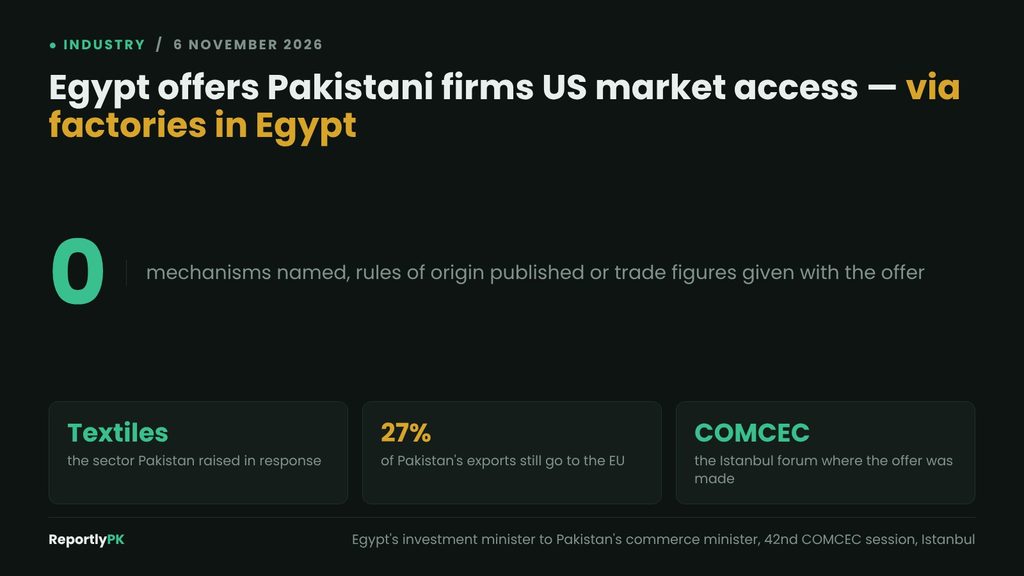
Egypt has invited Pakistani manufacturers to build factories on Egyptian soil and use Cairo’s preferential trade arrangements with Washington to obtain US market access for the output — subject, the offer notes, to applicable trade requirements.
Egypt’s Minister of Investment and Foreign Trade, Mohamed Farid Saleh, made the proposal to Pakistan’s Commerce Minister Jam Kamal Khan on the sidelines of the 42nd session of the Standing Committee for Economic and Commercial Cooperation in Istanbul.
What is actually on offer
The mechanism was not named in the statement, which matters because the detail determines whether this is worth anything. Egypt’s principal route to duty-free US access for manufactured goods runs through arrangements that carry origin conditions — requirements about how much of a product’s value must be added in Egypt, and in some cases sourced from specific partners.
- Offer: Pakistani firms manufacture in Egypt, export to the US under Egyptian preferences
- Sectors raised by Pakistan: textiles, cotton, manufacturing and joint ventures
- Condition stated: compliance with applicable trade requirements
- Mechanism named: none
- Trade figures published: none
Without the origin rules, a Pakistani textile firm cannot calculate whether this works. If the arrangement requires substantial local value addition, shipping Pakistani yarn to Egypt for conversion may not qualify the finished garment — and if it does qualify, the question becomes whether the duty saved exceeds the cost of operating a second production base.
Why the timing lands
The offer reaches a textile sector that has spent this year watching its trade preferences erode. Pakistan must now reapply for GSP+ status rather than holding it by default, and the EU-India free trade agreement has given Indian textile and apparel exports duty-free access across all tariff lines into Pakistan’s second-largest market.
Roughly 27 percent of Pakistan’s exports go to the EU-27, and close to $7 billion of textile shipments a year. An alternative route into a different large market has obvious appeal when the existing one is under review.
It also lands as Pakistan and the United States pursue a revised trade arrangement of their own, which raises a question the statement does not address: whether manufacturing in Egypt to reach American buyers makes sense if direct access improves.
Related: Pakistan must reapply for GSP+ — and the EU-India deal has already cut what it is worth
Investing abroad to export
There is a structural tension in this proposal that deserves stating plainly. Pakistan’s policy problem is attracting investment into the country, not sending it out.
A Pakistani firm that builds a plant in Egypt employs Egyptians, generates Egyptian exports and holds assets outside Pakistan. The benefit to Pakistan is whatever profits are repatriated and whatever inputs are shipped from home — which is precisely what the origin rules will determine.
Capital is also the binding constraint. The companies with the balance sheet to open a second manufacturing base abroad are the large integrated textile groups, and those are the same firms being asked to invest in domestic capacity, certification and energy efficiency. Rs1.995 trillion of Punjab’s industrial programme is predicated on Rs906 billion of private money that has not yet been committed.
The rest of the Istanbul round
The Egyptian meeting was one of several. Khan met Saudi Arabia’s Deputy Governor for International Organisations and Agreements, Fareed S Alasaly, on agriculture, industrial development, human resources, livestock and food security. He met Tunisia’s Trade and Export Development Minister, Samir Abid, on agriculture, minerals, textiles, auto parts and manufacturing.
Both sides in the Tunisian meeting agreed that bilateral trade sits well below its potential. No figures were given, which is a recurring feature of these engagements — the phrase appears in almost every such readout and is never accompanied by a baseline.
The model Egypt is selling
Manufacturing in a third country to reach a fourth is an established strategy, and it is worth being clear about what it is for. It exists to arbitrage trade policy: a producer locates where the tariff treatment is favourable rather than where production is cheapest.
That makes it durable only as long as the policy is. Preferential arrangements are renegotiated, suspended and allowed to lapse, and a factory is a fifteen-year asset built on a trade term that may not last five. Pakistan is currently experiencing exactly this from the other side with GSP+.
Egypt’s own interest is straightforward and legitimate: it wants manufacturing investment, employment and export volume, and its US arrangements are the asset it has to attract them. Recognising that does not make the offer a bad one for Pakistani firms. It does mean the proposition should be assessed as Egypt’s industrial policy rather than as a favour to Pakistani exporters.
What would make this real
Saleh asked for the names of Pakistani companies attending an upcoming business forum, which is the most concrete element in the exchange and the thing to watch. A list of firms is a step; a ministerial statement is not.
Three things would turn this into an assessable proposition: the specific preferential arrangement being invoked, its rules of origin, and the current volume of Pakistan-Egypt trade against which any growth would be measured. None has been published.
Until they are, this is an invitation rather than an opportunity — and Pakistani exporters have had a year of invitations.