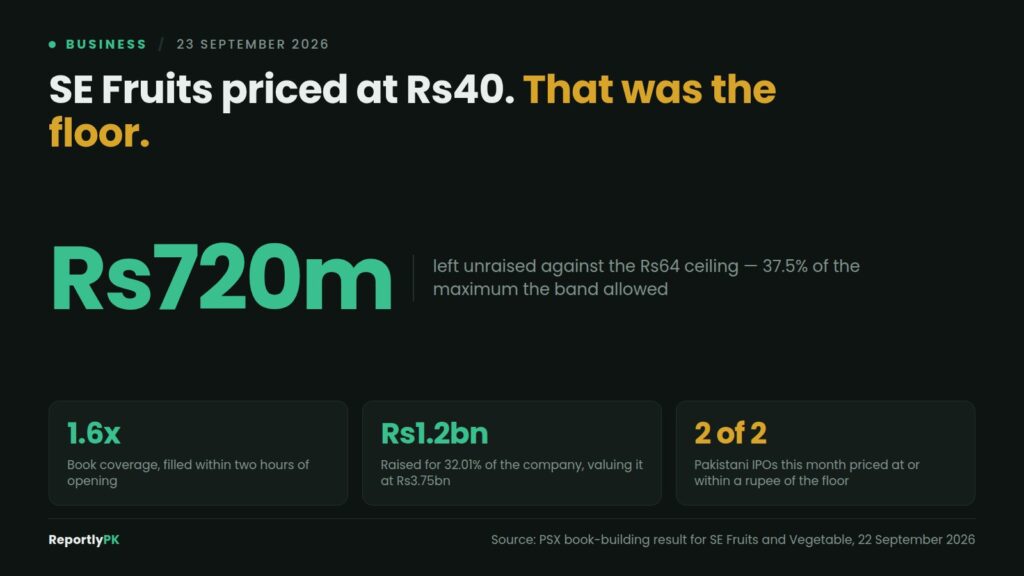
The SE Fruits IPO strike price came in at Rs40 — the floor of a band that ran to Rs64. The book was covered 1.6 times and the institutional tranche was fully subscribed within two hours of opening.
Both of those facts are true and only one of them was reported as the headline. Demand arrived quickly. It arrived at the lowest price the company said it would accept.
What the company actually got
- Rs900 million from 22.5 million shares in book-building
- Rs300 million from 7.5 million shares to the public on 28 and 29 September, at the same Rs40
- Rs1.2 billion total, for 32.01 percent of the company
At the Rs64 ceiling the same 30 million shares would have raised Rs1.92 billion. The gap is Rs720 million, or 37.5 percent of the maximum the structure was built to achieve. The implied valuation settles at about Rs3.75 billion against the Rs6 billion the top of the band implied.
Two hours and no premium
The speed of subscription is genuinely informative, just not in the direction the coverage implies.
A book that fills in two hours and then clears at the floor describes investors who had already decided what the company was worth before the process opened, and who were not going to be drawn upward by competition. Coverage of 1.6 times means bids exceeded shares by 60 percent. It says nothing about the price of those bids, and the strike price says everything.
Put plainly: there was appetite for the asset and none for the premium.
This is now a pattern
Eight days before this, APAG completed a book-building exercise on a Rs32 to Rs44.80 range. It was covered 1.84 times and struck at Rs33 — one rupee above its floor.
Two consecutive Pakistani IPOs, two comfortably covered books, two strikes at or within a rupee of the floor. That is no longer a comment on either company. It is a statement about the market they listed into.
Pakistani institutions are participating — which after a decade of a moribund primary market is the important part — but they are pricing conservatively and holding the line on valuation. Issuers and their advisers are setting bands with upside they are not being paid for. SE Fruits asked for a 60 percent spread between floor and ceiling; APAG asked for 40 percent; neither got more than a rupee of it.
Floor pricing is not a failure
The argument on the other side is real and worth making properly.
SE Fruits wanted Rs1.2 billion and has Rs1.2 billion. An issue priced at the top of its range frequently breaks below issue in the first weeks, which damages the register, sours retail investors on the next deal and makes a follow-on raise harder. A company that lists at Rs40 with room above it has given its new shareholders something to gain, and the retail tranche opening on 28 September is being offered at a price institutions have already validated rather than one they bid up.
For a business whose constraint is seasonal procurement cash, the amount raised matters more than the multiple it was raised at. The company can buy more fruit in January either way.
What Rs1.2 billion means at this size
Set the proceeds against the business rather than against the band, and the transaction looks different.
Rs1.2 billion is roughly 1.1 times the company’s FY2026 export revenue of about Rs1.1 billion. For a seasonal procurement business, that is not incremental funding. It is a step change in the size of cheque the company can write at harvest, and the harvest cheque is what determines how much fruit it can ship.
Whether the strike landed at Rs40 or Rs64 does not change that. It changes how much of the company the founders gave up to get it. At Rs40 they sold 32.01 percent for Rs1.2 billion and retained a stake worth about Rs2.55 billion on the listing valuation. At Rs64 they would have raised Rs1.92 billion for the same 32.01 percent.
So the Rs720 million left on the table is a cost borne by the existing owners, not by the business. That distinction is why a company can price at its floor and still have run a successful IPO — and why the people who should be unhappy about the strike price are the sellers, not the buyers.
What retail investors still do not have
The public offering is six days away and the disclosure gap noted here yesterday has not closed.
The figure in circulation is roughly $4 million of export revenue in FY2026 — about Rs1.1 billion. That is one revenue line. Total turnover, gross margin and profit after tax have not appeared in any of the coverage, which means the price-to-earnings ratio anybody would actually buy this on is absent from the public conversation entirely.
Those numbers are in the prospectus and institutional investors have read them. A retail buyer deciding on 28 September deserves them in the news coverage too, because Rs40 is only cheap or expensive relative to something, and the something has not been printed.
What to watch next
Three things. Whether the retail tranche on 28 and 29 September fills at Rs40 without institutional competition underneath it. Where the stock trades in its first fortnight, which settles the argument about whether floor pricing was discipline or a discount. And whether the next issuer to come to market sets a narrower band, having watched two companies leave the top of theirs untouched.
Related: SE Fruits Wants Up to Rs1.92 Billion. Its Export Revenue Last Year Was About Rs1.1 Billion.