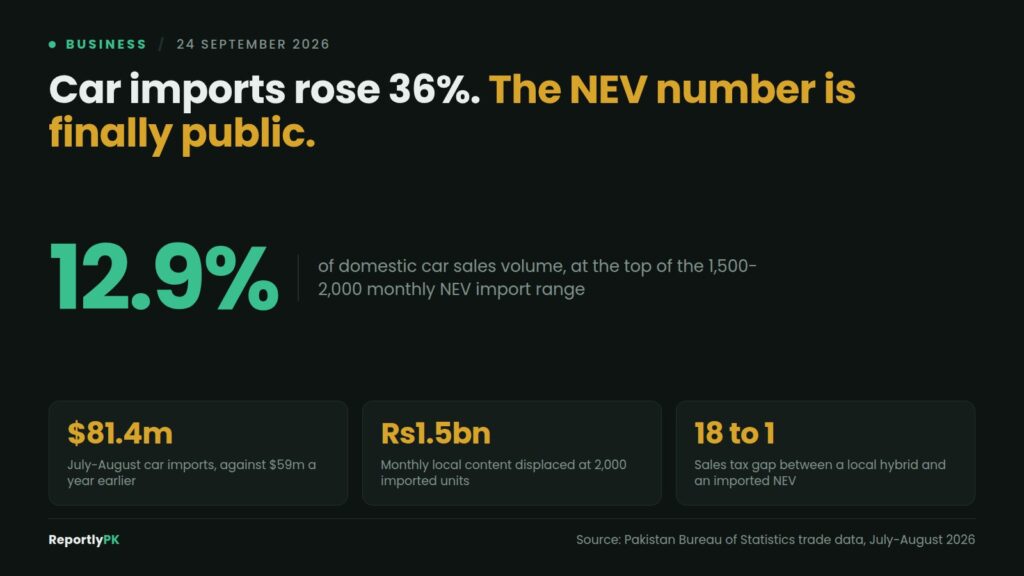
Pakistan car imports reached $81.4 million across July and August, up 36 percent on the $59 million recorded in the same two months last year, according to Pakistan Bureau of Statistics data. New energy vehicles are arriving from leading Chinese manufacturers at 1,500 to 2,000 units a month.
That second figure is the one worth pausing on. When local assemblers blamed August’s 21 percent monthly sales fall partly on competition from new energy vehicles, this site noted they had published no NEV numbers and the claim could not be tested. It now can be.
The claim checks out
Local assemblers sold 15,558 cars in August. Against that, monthly NEV imports of 1,500 to 2,000 units are equivalent to between 9.6 and 12.9 percent of domestic car sales volume.
A segment arriving at roughly a tenth of the volume of an entire domestic industry, in a market that was not buying them at all two years ago, is a material competitive event. The industry’s complaint was not manufactured. It was simply made without the number that substantiates it, which is a different failing.
One caution on the arithmetic. The $81.4 million import bill and the unit figures come from different cuts of the trade data, and there is no published classification showing how NEV units map onto that value. They should be read side by side rather than divided into one another.
What each imported unit displaces
Aamir Allawala, a former chairman of the automotive parts association, argues that completely built-up imports — new or used — directly reduce demand for locally produced components and hit employment in the vendor industry. A locally assembled vehicle averages about Rs1.5 million with more than 50 percent localised content by value.
Take that at face value and each imported car displaces roughly Rs750,000 of domestic value added. At 2,000 NEV units a month, that is about Rs1.5 billion of local content not being manufactured each month, before counting used imports at around 3,200 units across the two months.
The interest disclosure matters here and should be made every time. The parts association represents firms that supply engine, transmission and fuel-system components, and an electric vehicle eliminates most of those categories outright. Its former chairman is describing a real effect and is also describing a threat to his own membership. Both things are true.
Used cars are the other channel
Roughly 3,200 used vehicles came in across July and August, about 1,600 a month. Add the NEV arrivals and completely built-up imports are running at somewhere near 3,350 units a month at the midpoint — around 21 percent of what the entire domestic assembly industry sold in August.
The two channels compete in different places. Imported electric vehicles land in the middle and upper segments. Used imports land at the entry level, which is where Pak Suzuki holds roughly half the market and where a buyer choosing between a three-year-old imported hatchback and a new locally assembled one is making a straight value comparison.
Used-car imports also arrive through a different policy door — the personal baggage, gift and transfer-of-residence allowances rather than commercial import — which is why the volume moves whenever those rules are adjusted and why it is rarely discussed in the same conversation as tariff policy. It should be. From an assembler’s order book the two are indistinguishable.
The tax code chose this
The competitive pressure did not emerge from nowhere. New energy vehicles carry a flat 1 percent sales tax. A locally manufactured hybrid up to 2000cc pays 18 percent, cut from 25 percent only on 13 September. A conventional car pays the full rate.
An importer bringing in a Chinese electric vehicle and an assembler building a hybrid in Karachi are competing on sticker prices that the state set eighteen points apart. Describing the outcome as import competition is accurate but incomplete. It is a policy preference operating exactly as written.
That preference has a defensible purpose — displacing imported fuel is the fastest route to a smaller energy import bill, and somebody has to go first. What it does not have is a localisation condition attached to the NEV concession, which is precisely what the parts industry has been requesting since August.
One import bill for another
The uncomfortable arithmetic for policymakers is that the tax preference converts one import into another.
A completely built-up electric vehicle reduces petrol imports over its life and increases vehicle imports on the day it lands. Whether that trade is worth making depends on how long the car stays on the road and how much fuel it actually displaces — and nobody has published that calculation. A Rs150 billion annual estimate of forgone revenue from NEV concessions circulated last month from an industry source, and no official tax expenditure figure has appeared to confirm or refute it.
Pakistan is running a significant industrial policy experiment without publishing the numbers that would let anyone score it.
What to watch
September’s sales data is the first clean read since the hybrid rate settled on 13 September. If local sales recover and NEV imports hold at 1,500 to 2,000 a month, both can grow together and the market is simply expanding.
If local volumes keep falling while imports climb, the 18-to-1 tax gap is transferring a domestic industry’s volume to foreign manufacturers, and the parts sector’s employment argument stops being special pleading and starts being a forecast.
Related: Car Sales Rose 11% and Fell 21% in the Same Month. Both Numbers Are True.